The homes with the lowest consumption and spending in all of Spain.
Passivhaus is a German construction standard for almost zero consumption housing, known in Spain as a passive house. It is the most demanding construction system in the world in terms of energy efficiency. They are high-quality homes, with great thermal comfort and almost zero energy consumption.
the buildings Passives manage to reduce heating and cooling needs by up to 75%. The little additional energy that they require can be easily covered through renewable energies, becoming a home with a very low energy cost for the owner and the planet.
There are 3 degrees of classification in Passivhaus buildings: Classic, Plus and Premium. This villa has a PASSIVHAUS PREMIUM classification since it has a primary energy demand well below the15Kwh/m2.year besides of having a primary energy production system using photovoltaic solar tiles, reaching practically zero consumption.
What is the Passivhaus standard?
5 fundamental pillars
Excellent thermal insulation
The entire building envelope has good insulation, reducing heat losses in winter and heat gains in summer, which is beneficial for energy demand; the exterior walls, the roof and the screed will have a low thermal transmittance.
High performance windows and doors
The holes are the “weak point” of the envelope. They are an important source of heat and cold losses, therefore, it is essential to have very high quality carpentry and glass. The carpentry used has a low thermal transmittance, double-glazed windows filled with argon gas. Low emission glass to reflect heat inside the house in winter and keep it outside in summer.
Design and construction free of thermal bridges
In passive buildings, the elimination of any discontinuity in the envelope material is rigorously controlled: corners, joints, etc… the so-called thermal bridges. They produce profit or loss unwanted and the surface temperatures in these areas are usually lower than those of the rest of the enclosure, which can cause the appearance of certain pathologies such as mold.
Air tightness
Air currents that occur in a home through windows, holes or cracks cause discomfort to the user and energy losses. In a Passivhaus construction, the envelope is as hermetic as possible, achieving air renewal through the mechanical ventilation system.
Mechanical ventilation with heat recovery
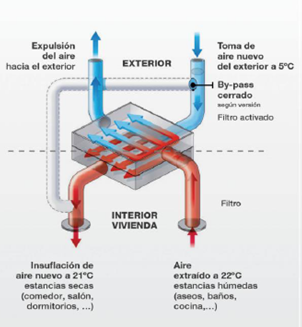
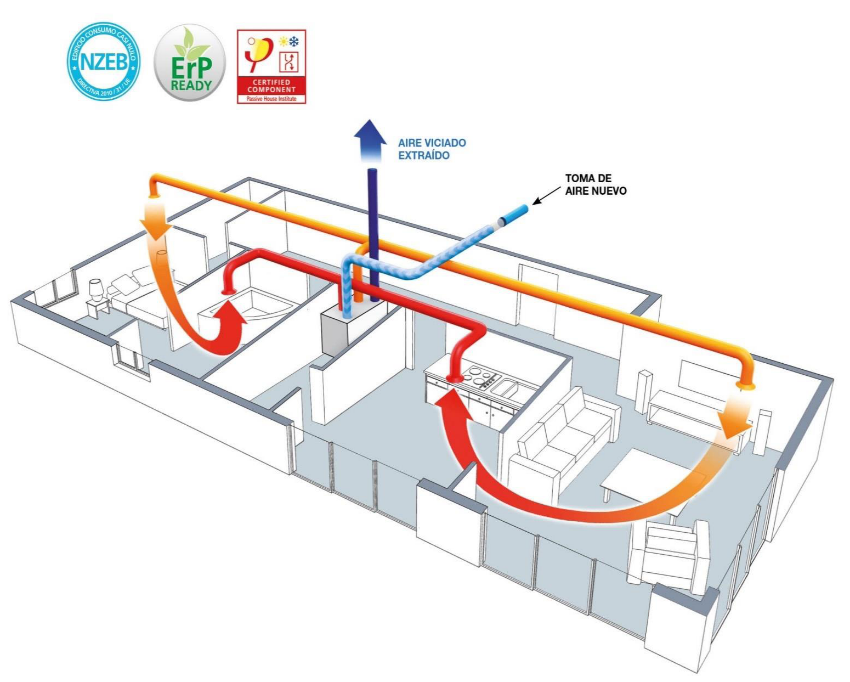
The ventilation equipment in a passive house has an exchanger to recover the heat from the house with a performance of up to 95%. This is how the outside air enters the house at a comfortable temperature. In this way, the energy needed to condition the spaces of the house is so small that we could cover it with a small contribution of heat in winter and cold in summer.
Benefits of living in a Passivhaus home?
Savings: It is estimated a saving of 90% compared to existing constructions. And a saving of 75% compared to new constructions.
Health: Mechanical ventilation promotes well-being, sleep and performance, while avoiding colds, allergies and creating a healthy environment for the little ones.
Maximum Comfort: The air is continuously renewed without the need to open the windows or install mosquito nets. Without bad smells, the appearance of mold and condensation is avoided. The temperature is pleasant all year round and without thermal changes inside the house.
Energy saving: The building is perfectly insulated, it is hermetic, avoiding outside air infiltration and it is ventilated, recovering the heat from the house. All this allows significant money savings in energy consumption.
Profitable property: The property increases its value and eliminates the energy mortgage.
Aesthetics: The standard does not imply the use of a specific type of product, material or architectural style, so it integrates perfectly into any type of construction.
Sustainability: Take care of your environment with fewer CO2 emissions into the atmosphere.